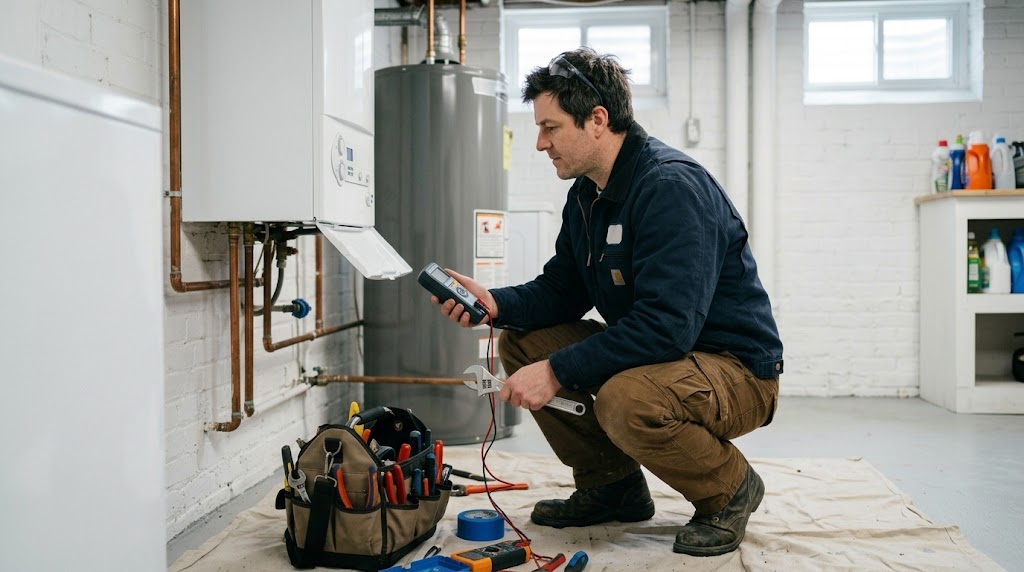
Dependable, component-level troubleshooting for gas, electric, and indirect storage water heaters across Buffalo, Elmwood Village, Allentown, and North Buffalo.
Western New York's harsh winter freeze cycles and older residential architecture place extreme operational strain on water heating equipment.
When municipal water from Lake Erie enters Buffalo basements at 35°F to 40°F, heaters must generate an 80°F temperature rise. Units with mineral scale struggle to recover, leading to lukewarm showers and prolonged burner cycles.
Explore Replacement Sizing →Drafty stone foundations in Allentown and North Buffalo can blow out weak pilot flames, while corroded thermocouples, blocked burner orifices, or failing gas valves prevent reliable ignition when hot water heater repair Buffalo service is needed.
View Boiler Heating Support →In electric storage tanks, mineral scale accumulates around lower 4,500W immersion elements, causing heat trapping that burns out the element wire and triggers the upper thermostat reset switch.
Compare Tankless Options →Recognizing subtle mechanical warnings early prevents sudden basement flood emergencies and cold morning water outages.
A complete absence of heat indicates an unlit pilot flame, burned-out electric immersion elements, a tripped thermal limit switch, or a defective gas valve assembly. Fast no hot water repair Buffalo diagnostics isolate electrical versus combustion failures.
Moisture near the base requires immediate inspection. If water originates from threaded fittings, unions, or the temperature and pressure (T&P) relief valve, repairs are straightforward. If moisture weeps through the jacket, the inner tank has rusted through, signaling a water heater leaking Buffalo crisis.
As calcium and magnesium precipitate out of municipal water, they form a hardened sediment layer along the tank floor. Water trapped beneath this mineral blanket boils violently, causing loud knocking and popping sounds during every heating cycle.
Discolored reddish-brown hot water accompanied by clear cold water indicates the internal magnesium or aluminum sacrificial anode rod has completely depleted, leaving the steel vessel vulnerable to aggressive oxidation.
Buffalo's diverse housing stock—from Victorian homes in Elmwood Village to South Buffalo bungalows—relies on different water heating engineering.
| System Type | Operating Characteristics | Common Malfunction Points | Recommended Service Approach |
|---|---|---|---|
| Atmospheric Gas Tanks | Natural gas burner, draft hood venting, millivolt pilot thermocouple. | Thermocouple wear, dirty pilot orifice, stuck gas valve, backdrafting. | Gas pressure testing, combustion chamber cleaning, flue draft check. |
| Power-Vent Gas Units | Electric exhaust blower pushes flue gas horizontally through PVC pipe. | Blower motor failure, vacuum pressure switch lockout, vent pipe ice. | Airflow pressure testing, electrical relay check, exterior vent clearing. |
| Electric Storage Heaters | Dual 240V immersion elements controlled by upper/lower thermostats. | Burnt lower element, tripped high-limit reset, loose wiring terminals. | Voltage & resistance multimeter testing, element replacement. |
| Boiler Indirect Tanks | Heats domestic water via internal hydronic coil linked to heating boiler. | Circulator pump lockup, zone valve motor burnout, internal coil fouling. | Hydronic loop bleeding, zone controller diagnosis, descaling. |
Natural gas is odorized with mercaptan (smelling like rotten eggs) to signal leaks. If you detect gas odor near your water heater or boiler, do NOT flip light switches, operate appliances, or use phones inside the building. Vacate the property immediately and call National Fuel Gas emergency line at 1-800-444-3130 or 911 from outside before contacting our repair desk.
We follow a methodical diagnostic sequence to isolate the root mechanical or electrical failure rather than replacing parts at random.
We inspect the equipment perimeter for active water pooling, combustible clearances, flue gas spillage, and electrical service disconnects.
For gas water heater repair Buffalo calls, we test millivolt thermocouple output and manifold gas pressure. For electric units, we measure line voltage and element resistance with calibrated multimeters.
We test the temperature and pressure (T&P) relief valve, inspect thermal expansion tanks for internal bladder rupture, and check water supply shutoff valves.
Defective components are replaced with factory-matched parts. The system is re-energized, tested under full operating temperature, and verified for clean exhaust draft.
Deciding whether to repair an existing water heater or invest in a new energy-efficient unit depends on equipment age, tank integrity, and financial practicality.
If your water heater is under 8 years old, the tank shell is dry and rust-free, and the issue involves an external component—such as a thermocouple, heating element, thermostat, T&P valve, or brass drain spigot—repair is virtually always the most economical choice.
When a storage tank exceeds 10 to 12 years of age and exhibits internal rust, outer casing leaks, or severe sediment binding, spending money on short-term repairs is unwise. Replacing the unit prevents catastrophic tank ruptures and provides superior recovery during sub-zero Western NY winters.
Learn About Replacement Options →A healthy water heater relies on the integrity of your home's entire plumbing and heating infrastructure. Explore our specialized related services:
When older tanks reach the end of their operational lifespan, we size, deliver, and install high-efficiency replacement units with code-compliant expansion tanks and haul away the old unit.
Replacement Details →Endless on-demand hot water, compact wall-hung space savings, and precision descaling services specifically calibrated for Buffalo's cold winter groundwater supply.
Tankless Solutions →Steam and hydronic hot-water boiler diagnostics, no-heat troubleshooting, circulator replacements, and pressure relief valve service for older Buffalo homes.
Boiler Diagnostics →Emergency thawing and pipe reconstruction for water supply lines exposed to extreme lake-effect freeze snaps in basements, crawlspaces, and exterior wall bays.
Frozen Pipe Service →Motorized mechanical snaking and high-definition video camera inspections to eliminate stubborn clogs, grease buildup, and slow drainage in Buffalo households.
Drain Clearing →Advanced fiber-optic camera locating, root intrusion clearing, and structural spot repairs for aging clay and cast-iron municipal sewer laterals.
Sewer Diagnostics →Pinhole leak detection, damaged copper section cutting, and localized repiping behind drywall and ceilings to halt hidden structural water degradation.
Pipe Leak Support →Rebuild constantly running fill valves, replace degraded wax flange seals, clear recurring toilet blockages, or upgrade to modern high-efficiency toilets.
Toilet Services →Stop constant drips, replace worn ceramic disc cartridges, fix loose sink bases, and install modern kitchen and bathroom sink fixtures.
Faucet Services →Our service trucks travel throughout the city daily. Whether you live in a historic home near Delaware Park or a modern build in North Buffalo, we provide rapid telephone dispatch.
Specialized water heater repair near Elmwood Village and water heater repair near Allentown for turn-of-the-century homes with historic piping and basement plumbing.
Reliable water heater repair near North Buffalo and Parkside, servicing traditional single-family and duplex residences with high domestic hot water demand.
Fast assistance for South Buffalo, Kaisertown, and Lovejoy properties facing cold climate water heater recovery challenges and pilot outages.
Practical answers to common residential water heating concerns in Western New York.
In winter, incoming municipal water from Lake Erie drops near freezing (35°F to 40°F). Delivering a comfortable 120°F shower requires an 80°F temperature rise—more than double summer requirements. Heavy mineral sediment inside the tank also insulates the bottom from the burner, dramatically slowing recovery rate.
Rumbling or popping is caused by mineral sediment accumulation. Dissolved calcium and lime settle at the bottom of the tank, trapping pockets of water beneath the sediment crust. When the burner fires, this trapped water reaches boiling point and bursts through the sediment layer like a miniature kettle.
It depends on the leak origin. Leaks from external fittings—such as the temperature and pressure (T&P) relief valve, dielectric unions, drain valve, or supply nipples—can be repaired by replacing components. However, if water is weeping through the outer steel jacket due to internal glass-lined tank corrosion, the unit must be replaced immediately to prevent catastrophic flooding.
A pilot light that extinguishes immediately usually indicates a worn or dirty thermocouple, an obstructed pilot orifice, a tripped thermal switch, or a defective gas control valve. Inspecting and testing these components with a multimeter allows technicians to restore safe ignition.
Speak directly with an experienced plumbing professional. Describe your symptoms and receive straightforward guidance over the phone.
Call +1 (315) 202-8009